
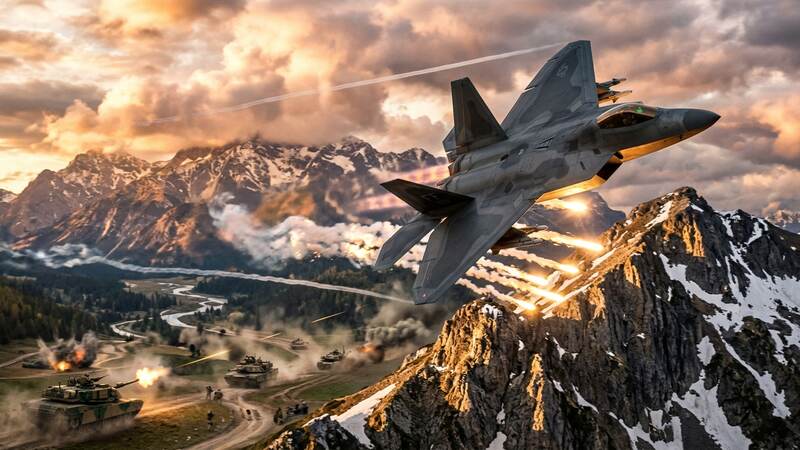
Combined-Arms Synergy: War Thunder is the only military simulation where player-controlled main battle tanks, scout vehicles, attack helicopters, supersonic strike aircraft, and radar-guided SPAA batteries clash simultaneously on the same battlefield. Mastering the Spawn Point (SP) economy, Active Scouting, and Pulse-Doppler radar notching allows you to control both the ground sector and the airspace above it.
1. The Ground Realistic Battles (GRB) Spawn Point Economy
In War Thunder Ground Realistic Battles, you begin every match with 450 Spawn Points (SP). Unlike Arcade mode (which grants three fixed tank spawns and temporary killstreak aircraft), GRB lets you bring your own custom-researched aircraft and helicopters in your crew slots—provided you earn the Spawn Points to deploy them:
- Light Tank "Active Scouting" & "Target Intelligence": Light tanks at Rank II and above unlock the Active Scouting (`V`) ability and the Airstrike Modification. Every enemy tank you spot with binoculars that is subsequently damaged by a teammate reduces the Spawn Point cost of your aircraft by 7% to 14% per assist! Two scouting assists and a zone capture allow you to spawn a fully loaded strike fighter or attack helicopter in under three minutes.
- CAP (Combat Air Patrol) vs. CAS (Close Air Support) SP Separation: Spawning a fighter jet with pure air-to-air missiles or cannon belts costs significantly fewer Spawn Points (~480–540 SP) than spawning with laser-guided bombs, AGM-65 Mavericks, or Kh-38MT missiles (~750–890 SP). Keeping a dedicated clean air-superiority fighter slot in your lineup lets you intercept enemy bombers before they can drop ordnance on your team's armor.
---
2. Modern Air Combat & BVR Radar Physics: Fox-1, Fox-2 & Fox-3
At high tiers in War Thunder, aerial combat transitions from gun-sight dogfighting into Beyond Visual Range (BVR) electronic warfare. Understanding the three NATO missile guidance classifications—and how to defeat each sensor—is essential for surviving top-tier skies:
| Missile Code | Guidance Physics | Examples in War Thunder | Definitive Defensive Counter-Play |
| :--- | :--- | :--- | :--- |
| Fox-1 (Semi-Active Radar Homing - SARH) | Requires launching aircraft to maintain continuous radar lock until impact | AIM-7M Sparrow, R-27ER, Super 530D | Notching (90° Beam Maneuver) + Chaff or hugging terrain below 60m to induce multipathing |
| Fox-2 (Infrared Homing - IR) | Passive heat-seeking head tracking engine plume / airframe skin friction; IRCCM resists basic flares | AIM-9M, R-73, Magic 2, AAM-3 | Cut afterburner immediately, pop flare bursts while changing flight vector, or use gate-width aspect |
| Fox-3 (Active Radar Homing - ARH) | Inertial + Datalink mid-course, then activates onboard nose radar transmitter ("Pitbull") at ~16km | AIM-120A/B AMRAAM, R-77, MICA-EM, Derby | Crank 45° post-launch to bleed missile kinetic energy, then execute a hard 90° notch + dive into ground clutter |
The Physics of "Notching" a Pulse-Doppler (PD) Radar
Modern fighters in War Thunder use Pulse-Doppler (PD) radar to filter out stationary ground clutter by measuring the relative radial velocity (Doppler shift) of targets moving toward or away from the emitter.
When your Radar Warning Receiver (RWR) screams with a continuous launch tone, turning exactly 90 degrees perpendicular to the enemy radar emitter reduces your radial closure velocity relative to their radar dish to zero. To the enemy's Pulse-Doppler filter, your jet now has the exact same Doppler velocity as the stationary mountains behind you—allowing a single packet of Chaff to break the lock immediately.
---
3. Naval Bluewater & Coastal Integration
Beyond ground and air warfare, War Thunder's Bluewater and Coastal Naval Battles apply the same internal compartment physics to destroyers, cruisers, and dreadnought battleships like the USS Iowa, IJN Yamato, KMS Bismarck, and RN Roma. Rather than trading hit-point bars, captains target boiler rooms, turret barbettes, and underwater shell magazines while dodging player-piloted torpedo bombers.
For a complete breakdown of shell types and crew skills, visit our War Thunder Tactical Guide and play War Thunder free on PC, PlayStation, or Xbox via the official link here.