
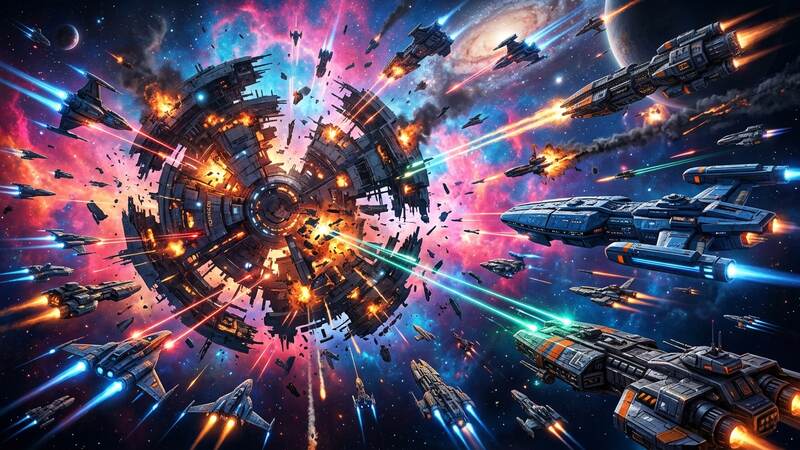
Unlike atmospheric dogfighters where gravity and wing stall speeds limit your turn radius, Star Conflict operates in full Six-Degrees-of-Freedom (6-DoF) orbital space. Your spacecraft can pitch, yaw, roll, and fire lateral RCS thrusters (`W/A/S/D` + `Spacebar` Up + `Ctrl/C` Down) simultaneously while keeping your mouse-aimed weapon reticles locked onto an enemy hull.
Whether you are piloting a Rank 15 Jericho Tackler in 6v6 Beacon Hunt or undocking an Ellydium Waz'Got frigate into the Open Space sandbox, victory depends on mastering the Rock-Paper-Scissors Class Triangle and Three-Element Resistance Math (EM / Thermal / Kinetic).
Title: The Star Conflict Damage & Faction Resistance Matrix
Badge: Fleet Engineering
- Empire Ships (Hull Tank Archetype): High base Hull HP and strong Kinetic resistance, but smaller Shield pools—vulnerable to Thermal laser beams and plasma that melt exposed armor.
- Jericho Ships (Shield Tank Archetype): Massive regenerating Energy Shields with high Thermal resistance, but fragile internal hulls once shields collapse—countered by EM (Electromagnetic) weapons and shield-bypassing phase cannons.
- Federation Ships (Speed & Evasion Archetype): Ultra-fast afterburner speeds (`520–650 m/s`) that dodge slow plasma projectiles—countered by hitscan Thermal lasers and ECM stasis webs.
1. The Corkscrew Lateral Vector (Defeating Railguns & Snipers)
Long-range Frigate snipers armed with Disintegrators or Gauss Cannons rely on linear lead indicators. If you boost toward a beacon in a straight line—or even a simple flat circle—their targeting computer calculates your exact position 1.2 seconds ahead.
To make your Interceptor or Fighter virtually untouchable at ranges beyond 2,500 meters, fly the Three-Axis Corkscrew:
1. Hold Forward Afterburner while rolling slowly with `Q` or `E`.
2. Cycle your lateral thrusters in a 1-second cadence (`D -> Space -> A -> Ctrl`).
Because your ship's velocity vector shifts across all three spatial axes every second, projectile weapons fired from >2,000m miss your hull silhouette completely without costing you forward closure speed.
2. How Interceptors Cripple Capital Destroyers
Colossal Rank 8–17 Suppressor Destroyers carry multi-directional energy shields and devastating Pyro-Emitters, but they suffer from slow turret rotation speeds and exposed rear Radiator / Pylon sub-targets. Never attack a Destroyer head-on inside its forward shield arc. Instead, use a Recon or ECM Interceptor to micro-warp directly inside its 400-meter point-blank blind spot beneath the rear engines, deploy a Stasis Generator to lock its weapon capacitors, and destroy the glowing thermal radiators to disable its active modules. Read our full Star Conflict Review for more fleet strategies.