
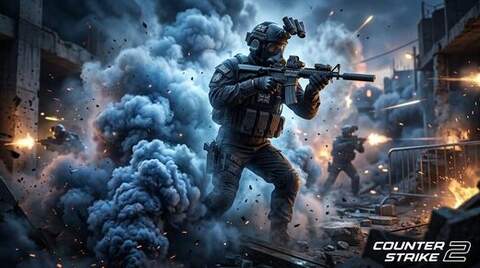
Watch a top-tier professional match in Counter-Strike 2 or Valorant and you will notice that the first 50 seconds of every round look less like a twitch shooter and more like high-speed chess. In-Game Leaders (IGLs) do not simply call "Rush B"; they fight for Mid-Map Rotational Connectors and count the opponent's exact Loss Bonus bank down to the last $100.
Whether you are climbing Premier ratings on Mirage and Inferno or grinding Ascent and Bind in Radiant queues, mastering three foundational laws of tactical shooter geometry will immediately elevate your win rate.
Title: The 3 Laws of Tactical Shooter Map Control
Badge: Esports Strategy
- 1. The Connector Triangle Law: Controlling Mid halves the defenders' rotation speed while cutting attacker site-switch time from 18 seconds down to 6 seconds.
- 2. The ≥75° Crossfire Rule: Two defenders holding the same choke point should never stand within 30° of each other's sightline; spacing at 75°–110° forces the entry fragger to flick a minimum of 90 degrees after the first contact.
- 3. The Double-Eco Prevention Threshold: Knowing when a single round loss drops the enemy from a `$1,900` loss bonus back to a `$3,850` force-buy trap dictates when to hunt exiting weapon savers.
1. Why Mid Control Dictates Bomb-Site Rotations
Classic tactical maps are structured around variations of the Four-Square or Three-Lane Cloverleaf layout: A Site, B Site, Middle, and the two Spawn baselines. If attackers only pressure A Main or B Main from their spawn side, defenders can keep one anchor on each site and float three rotators through their safe CT spawn corridor.
The moment attackers smoke off the enemy sniper nest and claim Middle (and its adjacent Connector/Vent), the defenders' safe horizontal rotation path is severed:
- Defenders rotating between A and B must now take the long path around their back spawn (+7 to +10 seconds of footsteps).
- Attackers can execute a Split Push (e.g., 3 players emerging from Mid-to-B Connector while 2 players pinch from B Main), collapsing the site anchor's single-angle hold.
2. Setting Up Un-Tradeable Crossfires
In solo-queue ranked play, defenders frequently stack two players inside the exact same cubby or peek the main choke point one after another in a series of 1v1 duels. Against a coordinated 5-stack, taking isolated 1v1s before the bomb is even planted gives the attackers free trade kills.
Instead, build a Bait-and-Switch Crossfire:
1. The Contact Player (Passive Jiggle): Holds a tight off-angle purely to spot the first shoulder entering the site, then immediately tucks behind solid geometry without over-committing.
2. The Crossfire Anchor (90° Perpendicular): Positioned across the site so that the moment the attackers turn their crosshairs toward the Contact Player, their exposed side profiles walk directly into the Anchor's pre-aimed headshot line.
Combine this spatial discipline with proper mouse polling and monitor synchronization covered in our 8000Hz Mouse Polling Rate Guide and CS2 Sub-Tick Netcode Breakdown.