
Written by Joel Ayuba, Lead Technical Analyst. Architectural security analysis grounded in x86-64 hardware privilege specifications and Windows Internals.
When Riot Games first mandated Vanguard for Valorant—and later expanded it to League of Legends—the PC gaming community erupted in fierce debate. Gamers questioned why an interactive entertainment software package required a boot-start kernel driver operating at Ring 0, the most privileged execution level of the central processing unit.
Today, nearly every premier competitive multiplayer title on PC—including Call of Duty (Ricochet), Rainbow Six Siege (BattlEye), Apex Legends and Fortnite (Easy Anti-Cheat)—relies upon kernel-level drivers.
To understand why game security engineers made this controversial architectural transition, we must examine the economics of game cheats: the demise of userland memory scanning, the rise of custom DMA hardware cards, hypervisor virtualization, and how modern OS safeguards maintain the boundary between integrity and privacy.
---
1. The x86 Privilege Rings: Userland vs Kernel Mode
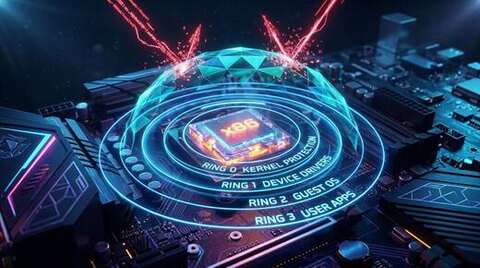
Modern computer processors enforce hardware-level privilege separation using concentric execution rings:
- Ring 3: User Mode Applications: Standard applications run here with restricted privileges. An application in Ring 3 cannot directly access physical memory addresses, hardware registers, or inspect the private address space of another Ring 3 process without explicit operating system permission via Win32 APIs like ReadProcessMemory.
- Ring 0: OS Kernel Mode: The core operating system resides here. Software operating at Ring 0 possesses total, unfettered access to all CPU instructions, physical RAM, hardware interrupts, and system peripherals.
- Ring -1: Hypervisor (VMM): Virtual Machine Monitor layer hosting virtualized environments.
The Fundamental Law of Software Security
> "If an adversary operates at a higher privilege level than your security software, the adversary can manipulate the security software's perception of reality."
In the early 2000s, anti-cheat solutions like Valve Anti-Cheat (VAC) and PunkBuster ran entirely in Ring 3.
Cheat developers quickly countered by creating Ring 0 rootkits. A cheat operating in Ring 0 could intercept ReadProcessMemory system calls, strip its own executable handles from the Windows object table, and feed completely fraudulent memory reads back to the userland anti-cheat. The anti-cheat scanned clean memory because the cheat driver sat underneath it, blinding its vision.
To even detect these kernel-level intrusions, anti-cheat software had no technical choice but to descend into Ring 0 alongside them.
---
2. The Modern Threat: DMA PCIe Cards and Hypervisors
The arms race escalated far beyond basic software driver injections. Today, commercial cheating operations deploy advanced hardware and virtualization techniques:
Direct Memory Access (DMA) Hardware Cheats
A DMA cheat uses a physical PCIe expansion board (often based on FPGA chips like the Xilinx Artix-7) installed directly into the cheater’s motherboard.
1. The FPGA card uses Direct Memory Access to read game memory directly over the PCIe bus, completely bypassing the CPU and operating system kernel.
2. The card streams raw coordinates out via high-speed USB-C to a completely separate secondary laptop.
3. The secondary laptop computes wallhack overlays or aimbot inputs, broadcasting them to an external video capture overlay or virtual mouse hardware dongle.
Because no cheat software ever executes on the gaming PC itself, traditional signature scanning is useless.
---
3. How Modern Kernel Anti-Cheats Defend the System
To combat DMA cards and hypervisor rootkits, modern kernel anti-cheat engines like Riot Vanguard and Activision Ricochet enforce strict boot integrity:
| Security Vector | Implementation Mechanism | Purpose |
|---|---|---|
| Boot-Start Initialization | SERVICE_BOOT_START driver loading | Ensures anti-cheat launches before any untrusted third-party kernel driver can establish rootkit hooks. |
| Driver Signature Enforcement (DSE) | EV Code Signing Certificates | Windows blocks unsigned drivers from executing in Ring 0, preventing cheat loaders from loading without exploit vectors. |
| Vulnerable Driver Blocklist (HVCI) | Hypervisor-Enforced Code Integrity | Blocks known legitimate third-party drivers (e.g., vulnerable RGB or overclocking tools) that cheaters hijack to execute arbitrary kernel code ("Bring Your Own Vulnerable Driver" attacks). |
| TPM 2.0 & Secure Boot | Hardware Root of Trust | Validates that UEFI firmware has not been compromised by a bootkit and binds hardware bans permanently to motherboard cryptographic chips. |
| DMA Protection via IOMMU | Direct Memory Access Remapping | Modern anti-cheats verify that IOMMU (Intel VT-d / AMD-Vi) is active, blocking unmapped PCIe peripherals from reading physical memory ranges allocated to game processes. |
---
4. Privacy Concerns vs Technical Realities
The primary objection to kernel-level anti-cheat software is privacy and system stability:
1. "Can a kernel anti-cheat read my private photos, banking documents, and browser history?"
- Technical Reality: Technically, any software running at Ring 0 has the authority to read arbitrary memory sectors. However, userland applications running in Ring 3 (like your web browser or Discord) can already read your documents, browser cookies, and local files without needing kernel rights. Anti-cheat companies are subject to rigorous regulatory audits (e.g., GDPR, SOC 2) and code signing governance. Ingesting arbitrary user data would destroy their multi-billion-dollar enterprise.
2. "Does a boot-start driver cause Blue Screens of Death (BSOD)?"
- Technical Reality: Because Ring 0 code executes without memory page fault protection, an unhandled exception or null pointer dereference inside a kernel driver instantly triggers a Blue Screen to protect storage integrity. While early builds of Vanguard suffered from rare conflicts with obscure third-party temperature monitors, modern kernel anti-cheats maintain exceptional stability records through automated crash telemetry and static code verification.
3. "Why not use Linux or SteamOS?"
- Technical Reality: Because Linux permits root users to recompile the kernel, build custom kernel modules, and manipulate memory freely without Microsoft's centralized WHQL driver signing restrictions, establishing a verifiable hardware root of trust on open Linux distributions is exponentially more difficult. This is why titles like Valorant remain incompatible with SteamOS.
---
5. Summary: The Inevitable Trade-Off of Competitive Integrity
In an ideal world, game developers would prefer to avoid maintaining complex, signed kernel drivers with round-the-clock driver telemetry. But as long as multi-million-dollar esports prize pools and ranked ladders exist, cheat developers will invest hundreds of thousands of dollars developing low-level hardware exploits.
Kernel anti-cheat architectures represent a calculated engineering compromise: accepting a signed, audited security driver running at Ring 0 in exchange for fair, cheat-free competitive play.