
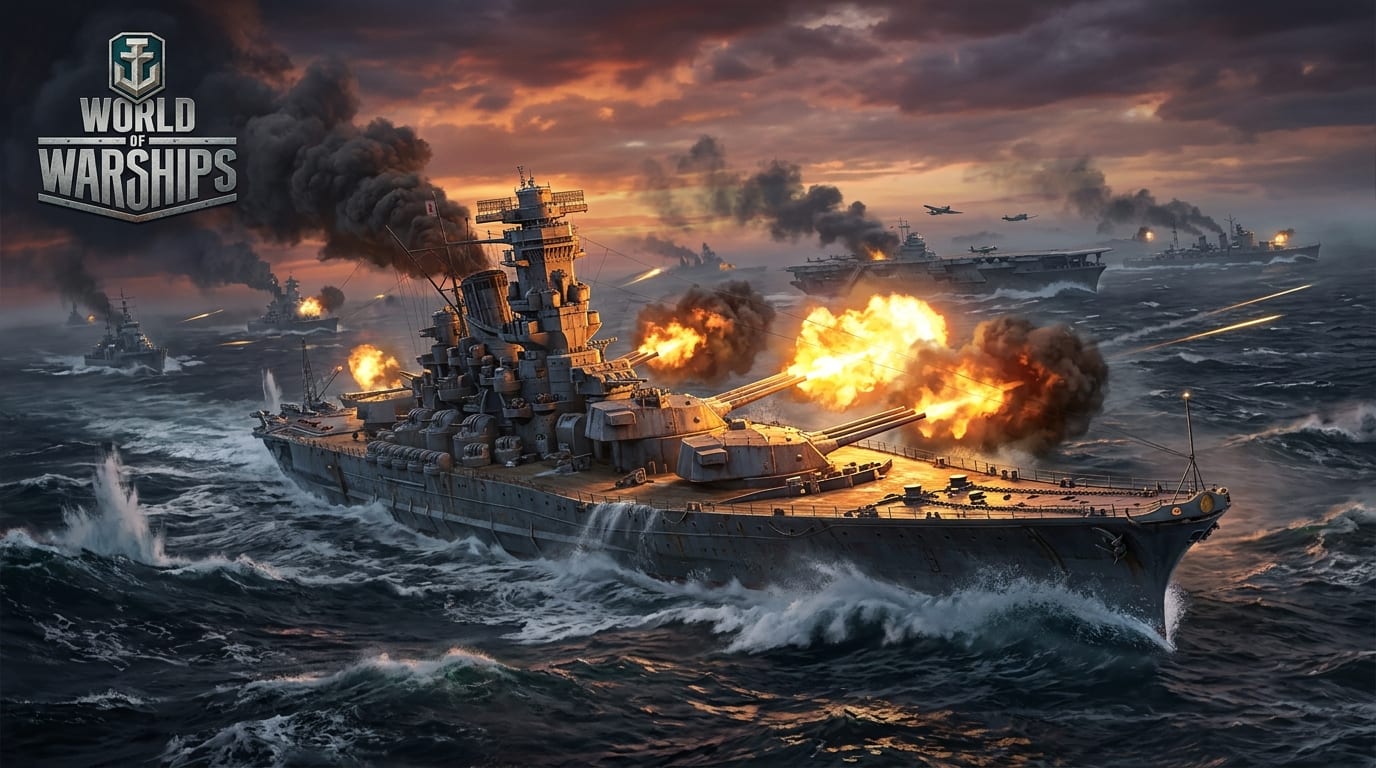
There are games that make you feel busy, and then there are games that make you think. Those two things aren't always the same.
At first glance, World of Warships can look like a fairly straightforward naval combat game. You choose a ship, sail toward the opposing team, aim your guns, and try to sink whatever gets in your way. That description isn't exactly wrong, but it misses the part that makes the game surprisingly interesting: the shooting is only one piece of the puzzle.
A battleship can have enormous firepower and still spend most of a match being ineffective. A destroyer with comparatively limited health can influence an entire flank without constantly firing its guns. A cruiser can appear to be in a strong position one minute and become an easy target the next simply because it pushed too far forward. Even a player who has excellent aim can make a terrible decision several minutes before the shot is ever fired.
That's what caught my attention about the game's design.
The more you look at World of Warships through a tactical lens, the less it feels like a conventional shooting game and the more it resembles a constant exercise in positioning, timing, information, risk management, and decision making. The interesting question isn't simply, "Can I hit that ship?" It's also, "Should I be here? What does the enemy know? What happens if I fire now? Which ship should I pressure? When should I retreat?"
And that's where the real game begins.
Positioning Matters More Than Aim
In many action games, mechanical skill can compensate for poor positioning. If you find yourself in a bad spot, fast reflexes, quick movement, or sheer aim can sometimes get you out of trouble.
World of Warships doesn't work that way.
Warships are massive, heavy machines. They don't turn on a dime. They don't accelerate instantly. And once you commit to a turn or a push into an open area, you are locked into that decision for a significant amount of time.
If you turn your broadside toward an enemy battleship while you're spotted, you cannot simply dodge the incoming salvo. If you push into a capture point without support and run into three enemy ships, you cannot easily back out before taking massive damage.
That deliberate pacing changes the nature of the game.
Aiming matters, of course. You still need to lead your targets properly, understand armor angles, and choose the right ammunition for the situation. But aim only matters once you've put yourself in a position to shoot without being destroyed in return.
In other words:
- Bad positioning with good aim usually leads to a quick trip back to port.
- Good positioning with average aim can still win games.
A battleship that parks behind an island far away from the battle might survive for twenty minutes, but if its guns aren't threatening important areas of the map, that survival means very little. At the same time, a battleship that charges forward without paying attention to enemy torpedo destroyers will often sink before dealing meaningful damage.
The sweet spot—where your ship is close enough to influence the match, angled well enough to survive incoming fire, and positioned to support your team—is constantly shifting. Finding that balance is one of the most rewarding parts of the game.
The Information Game: Vision and Concealment
One of the most sophisticated systems in World of Warships is how it handles vision.
In many shooters, you can see whatever is in your line of sight. In World of Warships, visibility is determined by a system of detection ranges, smoke screens, terrain obstacles, and aircraft spotting.
Every ship has a concealment rating. A stealthy destroyer might remain completely invisible until it gets within six kilometers of an enemy ship. A massive battleship, on the other hand, might be spotted from fifteen kilometers away.
Firing your main battery temporarily blooms your detection range to your maximum firing distance. That single mechanic introduces a layer of decision making that completely changes how engagements play out:
- Do you take that long-range shot at an enemy cruiser, knowing that firing will reveal your location to three battleships that can immediately shoot back?
- Or do you hold your fire, remain unspotted, and reposition to a flank where you can catch an enemy ship broadside?
This turns every shot into a calculated risk.
Destroyers play a central role in this information war. Because they are difficult to detect, they act as the eyes of the team. A skilled destroyer player doesn't necessarily need to deal the most damage to win a match; simply keeping key enemy ships spotted while staying safe can allow teammates to rain down fire from behind cover.
When you begin to understand concealment, the map stops looking like open water and starts looking like a game of vision control. The team that controls information controls the match.
Armor Angling and the Math of Penetration
Combat in World of Warships is governed by detailed ballistic and armor mechanics that reward knowledge and patience.
When armor-piercing (AP) shells strike an enemy ship, the game calculates the impact angle, shell velocity, armor thickness, and whether the shell will penetrate, shatter, or ricochet entirely.
If an enemy battleship is pointing its bow directly toward you, firing armor-piercing shells at its frontal armor will often result in harmless bounces. But if that same battleship turns slightly to bring all of its guns to bear, exposing its flat broadside, an AP salvo aimed at the waterline can penetrate the citadel—the most heavily protected internal space housing magazines and engine rooms—dealing devastating damage in a single volley.
This dynamic creates a constant tactical dance:
- Do you angle your ship defensively to minimize incoming damage, accepting that you can only fire your forward turrets?
- Or do you swing out to use your rear guns, risking a catastrophic citadel hit if an enemy fires at the right moment?
High-explosive (HE) shells provide an alternative tool, setting fires and dealing damage regardless of angle, which allows lighter cruisers and destroyers to wear down heavily armored targets over time. Knowing when to switch shell types, where to aim on a target's hull, and how to read the heading of an opposing vessel turns every artillery duel into a mental contest.
The Value of Patience in a World of Fast Games
Modern video games often prioritize speed. Matches are fast, movement is rapid, and downtime is kept to an absolute minimum.
World of Warships takes a noticeably different approach. A match can last up to twenty minutes, and the opening minutes often involve careful maneuvering, establishing map control, and probing enemy defenses before the first major engagement begins.
For players used to instant gratification, that pacing can feel slow at first. But once you appreciate the tactical depth, that slower tempo becomes the game's greatest strength.
It gives you time to think:
- You have time to look at the minimap and identify which flank needs reinforcement.
- You have time to notice that an enemy destroyer was spotted on the opposite side of the map, meaning your current area is temporarily safe from surprise torpedoes.
- You have time to plan an attack three minutes in advance.
That deliberate rhythm makes victories feel earned. When a well-executed crossfire destroys an enemy push, it doesn't feel like luck or random chaos. It feels like a plan that came together through teamwork, observation, and sound judgment.
Recommended Reading: The Architecture of Longevity
If you enjoyed exploring why decision-making, positioning, and tactical mastery turn World of Warships into an enduring experience, check out our companion analysis: Why Some Games Keep Us Playing for Years.
In that deep dive, we unpack the psychological mechanics behind video game replayability — exploring why titles that reward genuine player mastery and mental chess outlive games that rely purely on flashy graphics or endless grinding.