
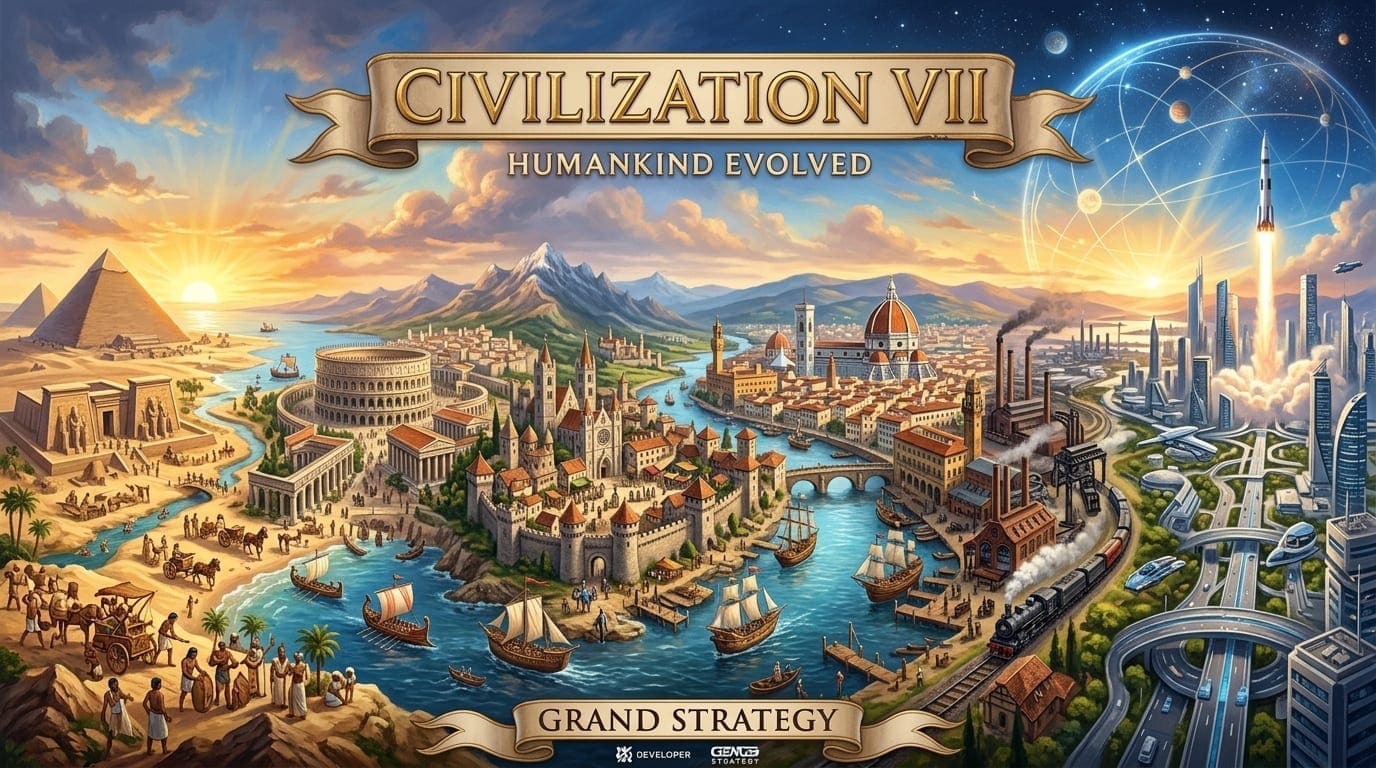
A strategy game can look surprisingly simple from the outside. You might be sitting quietly, staring at a map, moving units, collecting resources, building a base, or deciding whether to attack or defend. There may be no frantic button-mashing and no requirement to react to something every second.
Yet inside that apparently quiet experience, the player can be dealing with a surprisingly complicated mental problem.
You have limited information. Your resources aren't unlimited. An opponent may be preparing something you haven't noticed. A decision that looks good now could create a problem ten minutes later. Sometimes you have to abandon a plan you've spent time building because the situation has changed.
That is what makes strategy games interesting from a cognitive perspective.
They don't simply ask, "Can you win?" They repeatedly ask you to decide what matters, what can wait, what information you should pay attention to, and what you're willing to sacrifice to reach a larger goal.
This is why the relationship between strategy games and the brain is more interesting than the old idea that video games are either completely beneficial or completely harmful. Different games place different demands on players, and even within the strategy genre, the mental challenge can vary enormously.
A turn-based strategy game may give you plenty of time to think through a decision. A real-time strategy game can force you to plan while simultaneously monitoring several things. A naval combat game such as World of Warships combines positioning, timing, information gathering, risk assessment, and tactical decision-making.
So, how do strategy games challenge the brain?
The answer isn't that every strategy game magically improves intelligence. The more reasonable explanation is that these games repeatedly exercise certain cognitive processes because successful play depends on them.
Strategy Games Turn Decisions Into Problems
One of the biggest differences between many strategy games and simpler forms of entertainment is that your decisions usually have consequences.
Imagine you're playing a game where you have enough resources to upgrade your economy or strengthen your military. You can't do both immediately.
Choosing one means delaying the other.
That's a basic example, but the same principle can become much more complicated as the game progresses. You may need to decide whether to expand your territory, protect what you already control, investigate an opponent's position, save resources for later, or take an immediate opportunity.
There isn't always a perfect answer.
Instead, you're trying to make the best decision based on the information available to you. This is one reason strategy games and problem solving are so closely connected. The player isn't simply following instructions. They're interpreting a situation, identifying a problem, considering possible solutions, and choosing an action.
Then the game provides feedback.
If the decision works, you learn something. If it fails, you have another piece of information to work with. That feedback loop is one of the most interesting parts of strategy gaming.
Planning Ahead Changes the Way You Play
Good strategy usually requires thinking beyond the immediate move.
A beginner might ask: "What should I do right now?"
A more experienced player starts asking: "If I do this now, what is likely to happen next?"
That small change in thinking can make a huge difference.
Suppose you're attacking an opponent's position. Winning the immediate fight might seem like the obvious objective, but what happens afterward? Are your units too damaged to defend themselves? Have you moved too far from support? Did the attack leave another part of your territory exposed?
The strongest decision isn't necessarily the one that produces the most immediate reward. Sometimes the better move is the one that creates a stronger position several turns or several minutes later.
This is where strategic planning becomes mentally demanding. The player has to hold a goal in mind while considering a sequence of possible actions.
Research into video games has found associations between gameplay and several areas of cognitive ability, including memory, spatial ability, visual attention, and cognitive control. A 2026 systematic review and meta-analysis covering 133 studies found a statistically significant but small association between video-game play and several cognitive domains. Importantly, the researchers did not conclude that every game produces the same effects or that gaming automatically makes someone more intelligent.
That's an important distinction. Playing a strategy game requires cognitive activity. Whether that activity transfers into meaningful improvements outside the game is a much harder question.
Working Memory Has to Keep Up
Strategy games can also put pressure on working memory.
Working memory is the ability to temporarily hold and work with information while performing a task. In a game, that might mean remembering where an enemy was last seen, what resources you currently have, which unit is damaged, what your next objective is, or what an opponent did a few moments earlier.
You aren't necessarily sitting there thinking about all of this consciously. Your brain is constantly updating the situation.
Imagine you're managing several units while watching an opponent move across the map. You notice one route has become dangerous, remember that another unit is approaching from the opposite direction, and adjust your original plan.
The information you were holding a moment ago may no longer be useful. You have to replace it.
That constant updating is one reason strategy games can feel mentally tiring even when you're physically sitting still.
Attention Isn't Just About Looking at the Screen
Strategy gaming also requires attention, but not necessarily in the way people first imagine.
It's not enough to stare at the screen. You need to decide what deserves your attention.
A busy strategy game may contain dozens of things happening at once. Some are important. Others are distractions.
If you spend too much time watching something that doesn't matter, you may miss the event that actually changes the game. This creates a useful distinction between simply seeing information and identifying relevant information.
Research on gaming and cognition has frequently examined attention and working memory, and researchers have noted that many modern video games require players to monitor complex environments, identify relevant and irrelevant information, and coordinate planning and decision-making.
Strategy games can therefore create situations where the player has to filter information rather than absorb everything equally. That skill becomes particularly important in real-time games.
Strategy Games Force You to Make Trade-Offs
One of the most underrated cognitive challenges in strategy games is learning that you can't have everything.
You may want stronger defenses, faster expansion, better equipment, and more resources. But the game gives you limited time or limited resources. Something has to give.
This creates trade-offs:
- Spending resources on a powerful unit might make you stronger immediately but leave you with less money for future development.
- Taking a shortcut might save time but increase your exposure to danger.
- Pursuing one objective may mean abandoning another.
These situations encourage players to think in terms of opportunity cost, even if they never use that term. You're essentially asking: "If I choose this, what am I giving up?"
That's a much more useful question than simply asking whether a particular move is good or bad.
Problem-Solving Happens When Plans Fail
Strategy games would be much easier if your original plan always worked. They don't.
An opponent makes an unexpected move. A resource disappears. Your attack fails. A carefully prepared defense gets bypassed. You discover that the strategy you copied from someone else doesn't work in the situation you're facing.
Now you have a problem.
This is where strategy games and critical thinking overlap. Critical thinking isn't simply knowing a lot of information. It involves examining information, questioning assumptions, considering alternatives, and adjusting your reasoning when the evidence changes.
A strategy game can create repeated opportunities for that kind of thinking:
- You make a prediction.
- The game responds.
- You compare the result with what you expected.
- Then you adjust.
That doesn't mean every player automatically develops better critical-thinking skills in everyday life. The transfer from a game environment to real-world abilities is complicated, and research on gaming has repeatedly shown that outcomes depend on the type of game, the gameplay features, the players, and the way cognitive changes are measured.
Still, the mental process itself is genuine. You're constantly testing decisions against consequences.
Cognitive Flexibility: Knowing When to Change Your Mind
A player can have a brilliant strategy and still lose because they refuse to change it. That's where cognitive flexibility becomes important.
Imagine deciding early in a match that you're going to play aggressively. Ten minutes later, your opponent has built a strong defensive position.
You have two choices: keep attacking simply because that was the original plan, or recognize that the situation has changed and find another approach.
The second option requires flexibility.
Strategy games can create these situations repeatedly because the game state is constantly changing. A strategy that made sense five minutes ago might be terrible now.
This is particularly obvious in real-time strategy games, where players may need to monitor several units, manage resources, and adapt their plans simultaneously. Research reviewing video-game cognitive effects has identified planning, cognitive flexibility, working memory, attention, and decision-making among the mental processes engaged by many games.
The important point is that adaptation isn't the opposite of planning. Good strategy usually requires both. You make a plan, but you remain willing to change it.
Risk Assessment Is Part of the Fun
Strategy games also make players think about risk:
- Should you attack now?
- Should you wait?
- Is the potential reward worth the possibility of losing?
There is rarely enough information to guarantee the outcome.
Consider a simple situation. You know your opponent has a stronger position, but you also know that waiting gives them more time to prepare. Attacking now could fail. Waiting could also make things worse.
That's a genuine decision under uncertainty. The player has to estimate possible outcomes and decide which risk is acceptable.
This is one reason strategy games can feel so satisfying. The enjoyment often comes from making a difficult decision with incomplete information and then seeing what happens.
Spatial Thinking Matters More Than Many Players Realize
Maps are not just decoration in many strategy games. Position can determine everything.
Where you place a unit, which route you take, how you approach an opponent, whether you control a particular area, and how far one unit is from another can all influence the outcome. That requires some form of spatial reasoning.
In a naval game, for example, positioning isn't simply about pointing your ship toward an enemy. You may have to think about distance, angles, cover, escape routes, visibility, and where another opponent could potentially appear.
The same basic idea appears in many other strategy games. You aren't only thinking about what to do; you're thinking about where to do it.
Spatial ability is one of the cognitive areas that recent research has associated with video-game play, although again, these findings shouldn't be interpreted as proof that every strategy game improves spatial intelligence in everyday life.
Why Strategy Games Can Feel Mentally Exhausting
There's a reason you can finish a long strategy session feeling mentally drained. Your brain has been managing decisions.
Even when the game is enjoyable, you're tracking information, comparing options, remembering previous events, predicting possibilities, and responding to changing circumstances.
The workload becomes particularly obvious when several systems interact:
- You're managing resources while watching an opponent.
- You're planning an attack while protecting your position.
- You're thinking about the current battle while also preparing for what comes next.
That's very different from simply reacting to one event at a time. The game may look calm. Your brain isn't necessarily having a calm time.
Not Every Strategy Game Challenges the Brain in the Same Way
It's tempting to talk about "strategy games" as though they're one giant category. They're not.
A turn-based strategy game can give you several minutes to analyze a position. A real-time strategy game may require rapid decisions while managing multiple systems. A grand strategy game can involve long-term planning and complicated resource management. A tactical game may place greater emphasis on positioning and short-term decision-making.
Even two games in the same genre can demand very different skills.
This is an important point in the research, too. A 2023 meta-analysis of video-game cognitive training found that specific gameplay features were more informative for predicting cognitive outcomes than broad genre labels such as "strategy" or "action."
In other words, simply calling something a strategy game doesn't tell us exactly what cognitive demands it creates. The details of the gameplay matter.
Does Playing Strategy Games Actually Make You Smarter?
This is where it's worth slowing down. It's easy to take research showing an association between gaming and certain cognitive abilities and turn it into a much bigger claim: "Strategy games make you smarter."
That's too simple. The evidence is more complicated.
A 2026 meta-analysis found a small association between video-game play and several measures of cognitive ability, but the authors also examined differences across factors such as game type, age, and intervention characteristics. Other research has found promising results in specific cognitive areas, while also highlighting problems such as differences between studies, game types, and methods of measuring transfer.
There's also an important difference between getting better at a game and getting better at a general mental ability. If you play the same strategy game for hundreds of hours, you're almost certainly learning that game's systems. You become better at recognizing its patterns, understanding its mechanics, and predicting common situations.
But that doesn't automatically mean you'll become better at every unrelated problem you encounter in school, work, or everyday life. That distinction is often lost when gaming research gets reduced to a catchy headline.
How to Get More Cognitive Challenge From Strategy Games
If you enjoy strategy games and want to make the experience more mentally engaging, you don't need to turn gaming into homework. A few simple habits can change how you approach a game:
- Think before reacting: When something goes wrong, resist immediately making another move. Ask yourself what actually caused the problem.
- Explain your decisions: Instead of thinking, "I'll do this," ask why. What are you expecting to happen? What could go wrong? What information are you missing?
- Try different approaches: If you always use the same strategy, you're mainly practicing one solution. Experimenting with different approaches forces you to adapt.
- Learn from losses: A loss can be more useful than a win if you understand why you lost. Did you misread the opponent? Spend resources badly? Ignore an important area? Commit too early?
- Don't confuse difficulty with quality: A game doesn't need to be brutally difficult to challenge your brain. A well-designed game can provide meaningful decisions without overwhelming the player. And sometimes a simpler game creates a deeper strategic problem than a complicated one.
The Bigger Picture
The interesting thing about strategy games isn't that they somehow turn gaming into a substitute for education or exercise. They don't.
The interesting part is that games can create environments where thinking has consequences:
- You make a decision.
- The game responds.
- You observe what happened.
- You adjust.
- Then you try again.
That combination of planning, attention, memory, problem-solving, risk assessment, and adaptation explains why strategy games can feel mentally demanding even when the player isn't moving around physically.
Research supports the idea that video-game play is associated with several cognitive abilities, but it also tells us to be careful about broad claims. The strongest interpretation isn't that every strategy game provides a guaranteed cognitive benefit. It's that different games create different cognitive demands, and some of those demands overlap with abilities such as attention, memory, spatial reasoning, and cognitive control.
For gamers, that's arguably the more interesting way to look at it. A strategy game isn't just a contest between you and an opponent. It's a constantly changing problem that asks you to decide what matters, predict what might happen, deal with uncertainty, and recover when your best plan falls apart.
And sometimes, the most valuable move isn't the one that wins the battle. It's the one that teaches you why your previous move failed.
Recommended Reading: Tactical Respite & Mindfulness
If you enjoyed exploring how deliberate tactical decision-making exercises your brain, dive into our reflective companion essay: World of Warships and Mental Wellbeing: What I’ve Personally Noticed.
Discover how focused naval positioning and strategic patience can offer a genuine mental break from daily stressors while cultivating healthy gaming boundaries.