
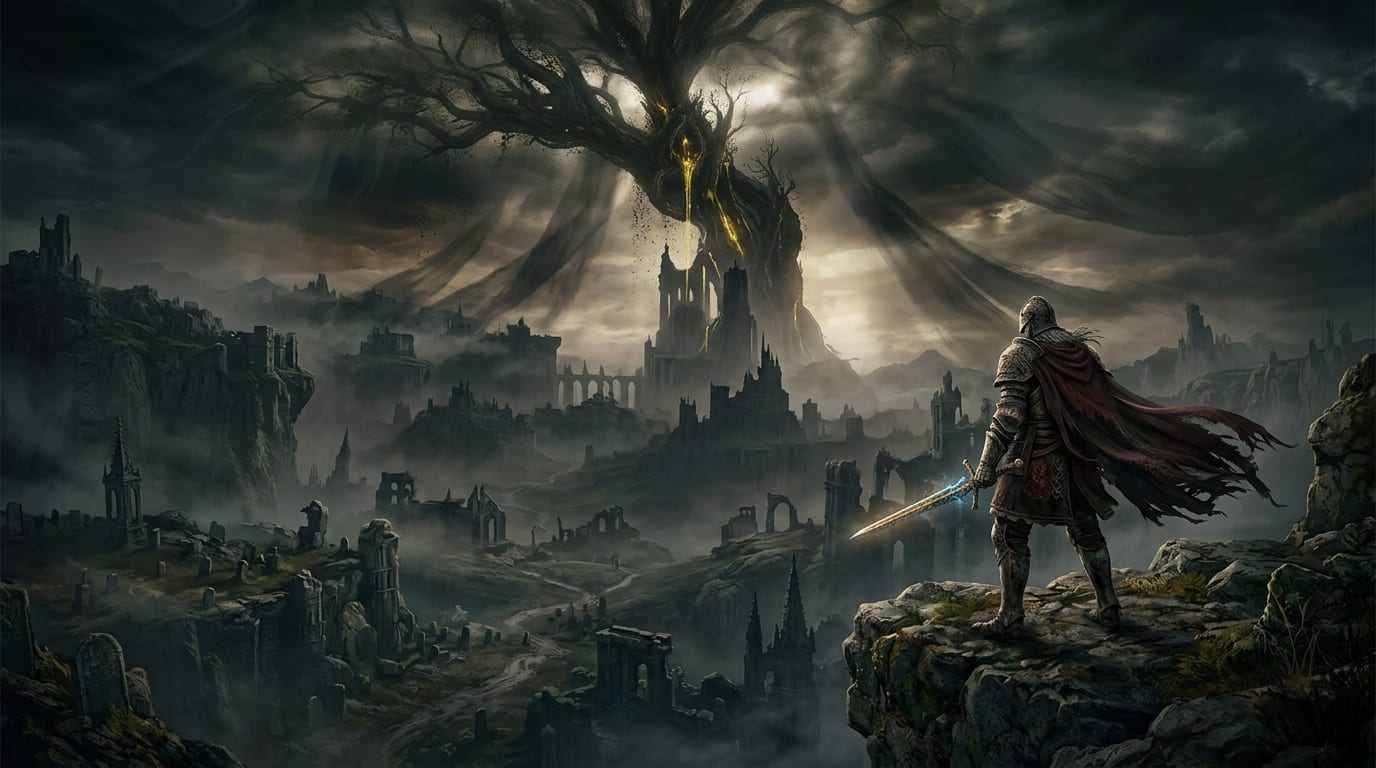
An editorial retrospective by Joel Ayuba, Founder of Game Vault Forum.
Modern game production operates under an unspoken law of additive accumulation.
Every sequel promises a larger map. Every marketing campaign highlights more side activities, denser crafting trees, expanded skill nodes, and more lines of recorded voice dialogue. If a developer has an extra hundred gigabytes of storage and forty teraflops of graphics processing headroom, the prevailing commercial impulse is to fill every square foot of virtual real estate with tangible content.
Yet, think about the moments in gaming that lingered in your consciousness years after you turned off your console.
Rarely is it the hundredth bandit camp cleared from a compass wheel. Rarely is it a cutscene explaining the political history of a fictional empire for fifteen uninterrupted minutes.
More often, it is a silhouette against an overcast sky. A stone bridge stretching into a quiet expanse of gray mist. The faint whistle of wind through a rusted iron portcullis.
These moments are not products of abundance. They are the deliberate output of Design by Subtraction (kankei no dezain), a creative doctrine pioneered by Fumito Ueda and perfected two decades later by Hidetaka Miyazaki.
---
Fumito Ueda and the 2001 Clean Slate
When Fumito Ueda and Team Ico began prototyping Ico on the PlayStation 2 in the late 1990s, they realized their early builds were suffocated by conventional game mechanics.
There were inventory menus. There were complex health meters. There were stamina gauges, multiple weapon pickups, and sprawling puzzle keys cluttering the screen. Every mechanical layer reminded the player that they were sitting on a couch, holding plastic dual-analog grips, interacting with software.
Ueda made a radical choice: he stripped every element that did not directly serve the emotional thesis of the game.
The entire adventure was whittled down to a boy with horns, a pale girl named Yorda, an abandoned fortress, and a single mechanic: holding hands.
To lead Yorda across crumbling stone parapets, you had to hold down the R1 shoulder button. Release the button, and your character dropped her hand. The PlayStation 2 controller vibrated with a gentle, rhythmic pulse when their palms touched.
There was no floating mini-map. There was no quest log notifying you that your current objective was “Find Key for South Gate (0/1).” The environment itself provided the visual language. Sunlight breaking through high lancet windows signaled safety; dark, bubbling shadows pooling on stone flagstones signaled danger.
By removing the digital machinery between the player's perception and the world, Ueda forced the human imagination to step into the negative space.
---
Shadow of the Colossus: The Eloquence of Empty Space
In 2005, Team Ico pushed subtractive architecture to its logical zenith with Shadow of the Colossus.
Consider the landscape of the Forbidden Lands. By modern open-world standards, it is an administrative disaster:
* No towns, villages, or taverns
* No friendly NPCs offering side quests
* No wandering bands of generic enemies to farm for experience points
* No shops to purchase upgraded swords or enchanted armor
There were sixteen colossi, an ancient stone sword, a horse named Agro, and vast valleys of golden grass swaying under pale, washed-out sunlight.
When you rode across the expansive plains between battles, the game fell silent. There was no combat soundtrack pounding in your ears. The only audio was the thud of hooves against hard dirt, the rustle of wind, and the occasional whinny of your mount.
That intentional emptiness was the point. The absence of conversational noise created an oppressive, melancholic isolation that made each confrontation feel like an unholy violation of an ancient sanctuary. You weren't a triumphant hero checking off a monster-hunting bounty; you were an intruder committing murder in an abandoned garden.
Had Ueda populated the Forbidden Lands with radiant quests and bandit outposts, that emotional weight would have evaporated into standard arcade noise.
---
FromSoftware’s Architectural Inheritance
Hidetaka Miyazaki has openly stated on multiple occasions that playing Ico inspired him to leave his comfortable career at Oracle and pivot into game development at FromSoftware.
That inspiration runs directly through Demon's Souls, Dark Souls, Bloodborne, and culminated in Elden Ring.
When FromSoftware announced that Elden Ring would be an open-world title, many industry observers worried the studio would surrender its tight, intricate dungeon design to the familiar open-world checklist formula.
Instead, FromSoftware applied subtractive design principles to a map spanning dozens of square kilometers:
1. The Ban on Compass Icons and Floating Markers
When you step out into the windswept fields of Limgrave, your screen is almost entirely free of UI chrome. There are no yellow objective icons hovering over distant castles. There is no compass crowded with question marks prompting you to inspect a generic chest.
If you see a towering golden tree on the horizon, you walk toward it because your own human eyes find it intriguing, not because an algorithm instructed you to clear a waypoint.
2. Environmental Architecture as Dialogue
Because FromSoftware refuses to rely on thirty-minute narrative exposition sequences, the physical geography must tell the story.
When you discover the Sunken Valley, the ruined battlements of Leyndell, or the weeping gravestones of the Land of Shadow, the architecture itself reveals the history. A collapsed bridge tells you a war took place. A pile of rusted iron armor outside a cave tells you whatever lives inside does not negotiate.
The player becomes an active archeologist rather than a passive consumer of pre-digested lore.
---
The Modern Open-World Problem: The GPS Trap
Contrast this with the prevailing design philosophy of contemporary big-budget open-world titles.
In many modern sandboxes, the game provides:
* A mini-map in the corner showing topography, enemy vision cones, and item locations
* A floating 3D waypoint tethered to the horizon
* A breadcrumb trail projected onto the dirt road showing the exact mathematical shortest path
* An audio companion who announces the solution to a puzzle after eight seconds of silence
When a game provides this level of guidance, a curious cognitive shift takes place: the player stops looking at the virtual world.
Instead of observing the architecture, noting distinctive rock formations, or listening for water streams, the player's eyes lock onto the mini-map in the top-right corner of their television. The multi-million-dollar photorealistic landscape turns into peripheral background wallpaper while the brain chases a yellow dot on a 2D radar screen.
The game ceases to be a spatial adventure; it becomes a commute.
---
Negative Space as a Design Superpower
In traditional Japanese aesthetic theory, the concept of Ma (間) refers to the pure space between things—the pauses between musical notes, the white paper surrounding a sumi-e ink stroke, the silence in a conversation.
Western media production often fears Ma. Silence is treated as dead air; an empty horizon is treated as wasted asset budget.
Yet the greatest interactive experiences understand that the human brain needs negative space to process meaning. When an action RPG bombards you with non-stop stimulation for fifty hours, you become numb. When a game has the confidence to let you ride through quiet rain for ten minutes without interruption, the sudden roar of a dragon crashing onto the lake surface carries genuine shock.
The power of Ico, Shadow of the Colossus, and Elden Ring does not stem from what their creators put inside the code.
It stems from what they had the discipline to leave out.