
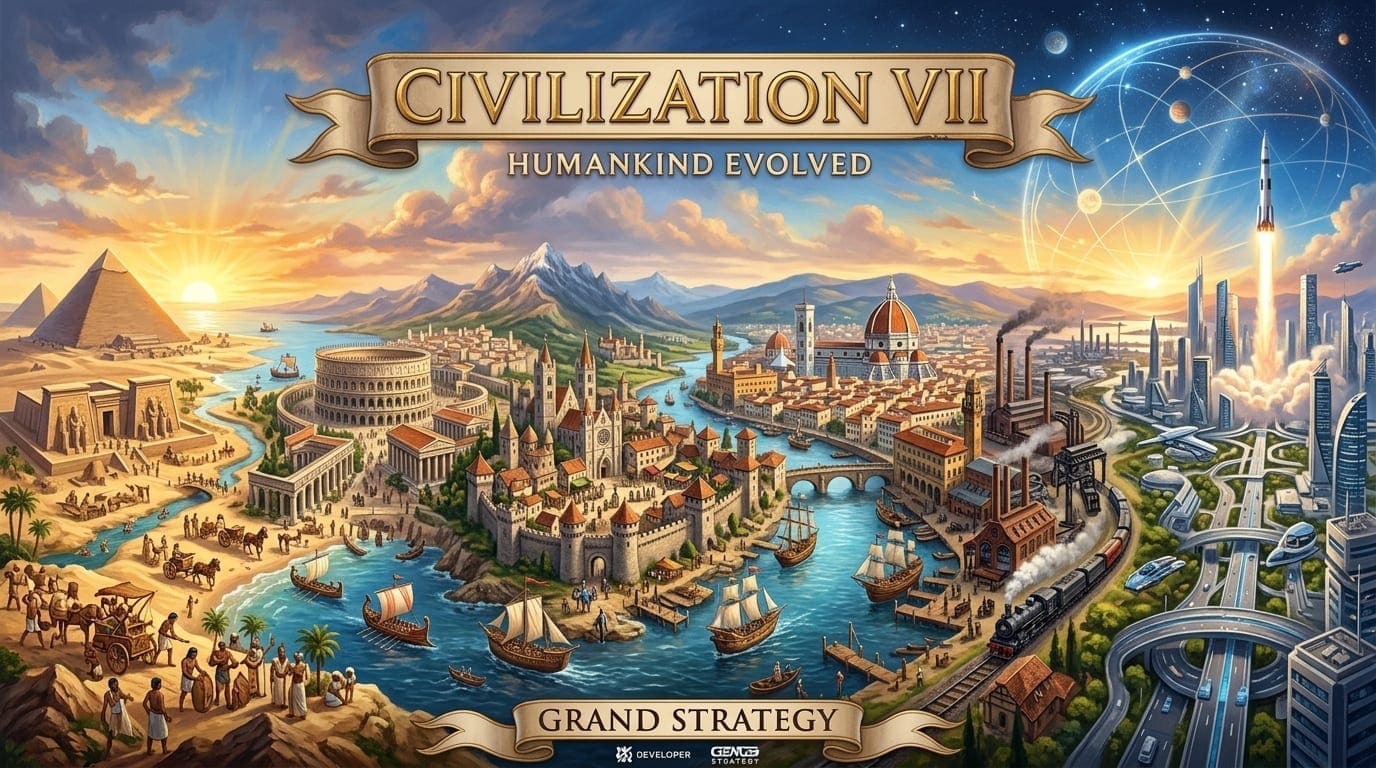
For over three decades, the Civilization series has defined the 4X genre (eXplore, eXpand, eXploit, eXterminate). Yet every seasoned veteran knows the historic design flaw that plagued Civ IV, V, and VI: the dreaded late-game slog. Once an empire crossed the tipping point into runaway industrial snowballing, the final hundred turns often devolved into repetitive unit shuffling and queue management.
In Sid Meier’s Civilization VII, Firaxis has solved this fundamental design challenge with their boldest architectural overhaul: Three Historical Ages (Antiquity, Exploration, Modern) punctuated by cataclysmic Crisis Mechanics.
Title: Key Civilization VII Innovations
Badge: Strategic Summary
- Three Distinct Ages: Antiquity, Exploration, and Modern each feature dedicated tech trees, civic trees, and unstacked district styles.
- Decoupled Leaders: Leaders are chosen independently from civilizations, allowing dynamic historical blending (e.g. Hatshepsut leading Rome or Benjamin Franklin commanding the Songhai).
- Crisis Milestone Pressure: Prevents runaway snowballing by imposing military, economic, or cultural catastrophes at the twilight of each age.
- Related Reading: Check out our scored critique in the Civilization VII Review and early game walkthrough in the Civ VII Age Transition Blueprint.
The Three-Age Paradigm: Ending the Late-Game Snowball
Instead of one unbroken 500-turn marathon from stone clubs to nuclear submarines, Civilization VII divides history into three distinct eras:
1. The Antiquity Age: Centered around immediate territorial discovery, river basin agriculture, pantheon formation, and foundational bronze/iron military legions.
2. The Exploration Age: Triggered once oceanic navigation and mercantile cartography are unlocked. The world map expands drastically, revealing distant continents, deep-sea trade routes, and religious reformation movements.
3. The Modern Age: The industrial explosion of factories, railways, ideological warfare (Democracy, Fascism, Communism), global stock exchanges, and space race aeronautics.
When an age concludes, your empire does not vanish. Instead, your cities consolidate into historical urban cores, obsolete units transition into cultural museum relics, and your civilization evolves into a new successor state that matches the geopolitical realities of the next era.
Mastering the Crisis System: Turn Pressure Under Uncertainty
The most exhilarating addition to Civ VII is the Crisis System. During the final 20% of an age, unrest mounts across the globe:
- Plague and Famine: Stagnates population growth in dense urban centers without clean water aqueducts.
- Barbarian Invasions & Pirate Flotillas: Spawns high-tier raiders along unattended borders and trade lanes.
- Economic Deflation & Social Uprisings: Penalizes gold upkeep and triggers rebel partisan uprisings if amenities are ignored.
Players must draft Crisis Cards that force agonizing trade-offs: do you slash army maintenance to fund agricultural famine relief, or do you draft peasant levies to crush border raiders at the cost of cultural output? Successful mitigation grants massive Legacy Points that carry over into the next age as unique Golden Age perks.
Turn Engine Performance & CPU Multi-Threading
A major technical leap in Civilization VII is the rewritten AI pathfinding engine. Previous entries in the franchise suffered from notorious turn wait times on massive maps with 12+ AI empires.
Using modern multi-threaded job systems, AI calculations run concurrently across modern 8-core and 16-core processors. Average late-game turn execution drops from 45 seconds down to under 6 seconds on modern hardware. Test your current setup's turn processing speed with our PC Requirements Checker and discuss optimum strategy builds on the Community Forum.